
FEM Analysis of the Composite Body of the TRIGO Light Vehicle – Case Study
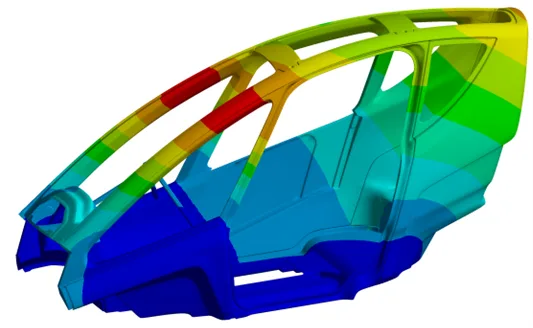
How does FEM support the structural assessment of light-duty vehicle bodies?
In an era of growing popularity of light vehicles, effectively protecting their occupants is one of the main challenges facing these designs. Additionally, these structures must be lightweight yet durable, meeting all requirements set forth by current regulations.
The task of the CIM-mes Projekt team was to verify the behavior of the composite body of the TRIGO light vehicle during tests: body load (ROPS) and the anchoring of the driver’s seat and passenger seat belts. Using the finite element method (FEM), we prepared simulations that demonstrated how the structure responds to various load scenarios, enabling its evaluation and the implementation of necessary modifications.
Legal Basis and Scope of the Structural Analysis
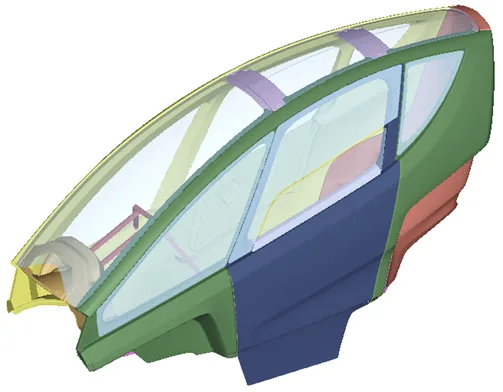
At the start of the project, we worked with the client to determine the loads to which the composite body structure would be subjected, based on Regulation (EU) No 168/2013 of the European Parliament and of the Council regarding functional safety requirements for vehicles for the type-approval of two- or three-wheeled vehicles and quadricycles, and in particular Annexes XI and XII of that document.
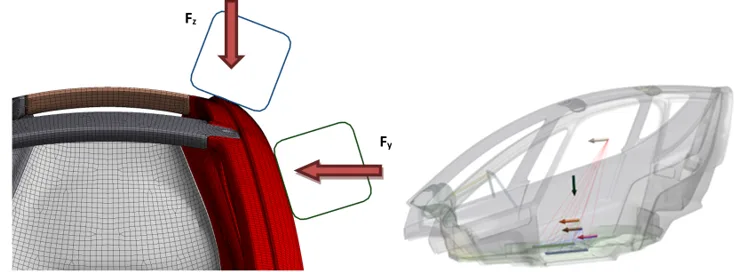
For the body analysis (ROPS), there were three vertical load scenarios. For the evaluation of seat belt anchorages, there were two load scenarios—one for the driver’s seat and one for the passenger. Thanks to these simulations, it was possible to precisely replicate the actual test conditions that every structure of this type must undergo.
Construction of the MES model – sandwich-type composite body
Due to the specific construction of the body (sandwich type), the FEM model was built using shell elements (composite shells) and solid elements (foam filling). In the computational model, a key aspect was the accurate representation of the number and arrangement of layers in the laminate and its connection to the foam filling.
Equally important was the representation of the body mounting points to the vehicle frame via spring connectors. This resulted in a realistic stress distribution, particularly for calculations involving seatbelt anchorages. The calculations were performed as a quasi-static FEM analysis. The results of these analyses are presented in the form of stress maps in various composite layers and as displacement maps.
Schedule free consultation with us
See how we can help your team work faster, without additional risk or cost.
Simulation Results – Identification of Structural Weak Points
Thanks to FEM simulations of the body, we were able to quickly and accurately assess whether there were any structural weak points in the form of stress concentrations or significant deformations. The results showed that, for most load cases, the structure meets the specified requirements.
In the analysis of the driver’s seat mounting points in the steel structural reinforcement elements, stress values higher than the allowable limits were obtained. Thanks to FEM strength analyses, these components could be modified before actual body testing began—saving both time and costs.
The result? The initial analysis showed that the structure was too weak. The lack of agreement in the calculations was a clear signal that the original design did not guarantee safety and required modification. This is a critical moment where simulation prevents costly errors during the production phase.
Modal analysis – evaluation of the body’s natural vibrations
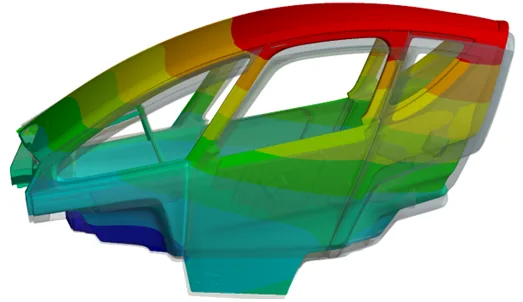
In the next stage, a modal analysis of the composite body was performed to determine its natural frequencies and modes. The goal was to enable the client to assess the risk of resonance with the forces encountered during driving.
Conclusions – Benefits of Using FEM in Vehicle Type Approval
Structural strength calculations in accordance with Regulation (EU) No. 168/2013 confirmed the consistent behavior of the composite body of the light vehicle in the analyzed scenarios. Key practical conclusions include the verification of the strength of critical structural areas and precise information regarding the structure’s stiffness.
Conducting advanced FEM analyses not only significantly reduced the time required to verify the structure but also provided the client with reliable data enabling informed design decisions. As a result, critical points in the structure could be identified and the safety margin determined at an early stage of project development without the need for costly real-world testing.
Book a meeting with us and get your training course today
Book a meeting with us!