
FEM Casing Analysis – Case Study

Designing specialized pressure vessels, especially those with non-standard geometries that cannot be calculated using standard formulas, is a common challenge for manufacturers in the industrial sector. The need to meet stringent safety standards, coupled with pressure to optimize weight and costs, requires the use of advanced engineering tools.
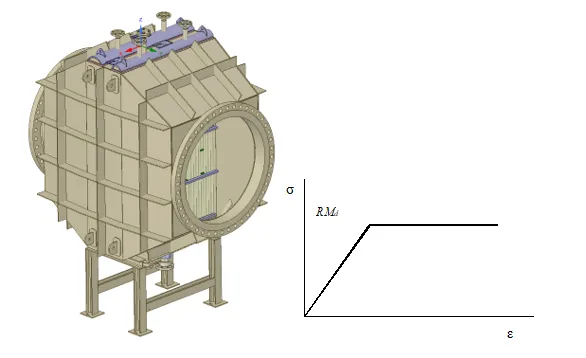
In this case study, we will demonstrate how our team utilized finite element method (FEM) strength calculations to verify and reinforce the design of a heat exchanger housing, ensuring its complete safety and compliance with EN 13445-3.
Customer Challenge: Safety of a Non-Standard High-Pressure Design
The customer faced the task of designing a heat exchanger housing with a non-standard, cuboid structure featuring flat walls. The unit was intended to operate under high pressure and temperature conditions and would additionally be exposed to loads from the installation and wind.
Key Engineering Challenges:
- Compliance with Standards: The design had to meet the stringent requirements of EN 13445-3, harmonized with the Pressure Equipment Directive (PED 2014/68/EU).
- Ensuring structural integrity: The unusual shape meant that traditional calculation methods using formulas were not applicable to this structure and could not be used to verify its safety.
- Structural optimization: A compromise had to be found between the required strength and the weight and cost of the reinforcements.
Solution Implemented: Advanced FEM simulations and design optimization
Based on our experience with similar structures, our team agreed with the client to perform analyses using an elastoplastic model (in accordance with Appendix B) and approached the problem iteratively, optimizing the model in successive steps using advanced FEM simulations.
Step 1: Model development and initial analysis
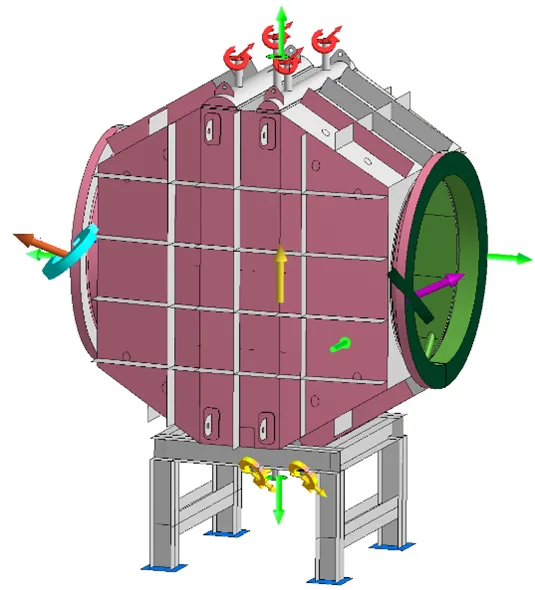
We created a shell-and-solid model of the structure, accounting for corrosion allowance and manufacturing tolerances. Next, in accordance with the guidelines of EN 13445-3, we performed a simulation using the GPD-DC (Gross Plastic Deformation Design Check) method.
The result? The initial analysis showed that the structure was too weak. The lack of convergence in the calculations was a clear indication that the original design did not guarantee safety and required modification. This is a critical moment where simulation prevents costly errors during the production phase.
Step 2: Design Modifications and Optimization
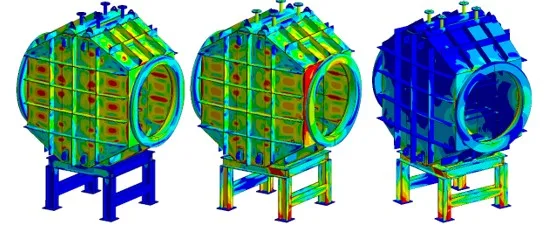
Using precise simulation data, we identified the design’s weakest points. We implemented a series of targeted changes:
- modified the spacing and thickness of the reinforcing ribs;
- increased the thickness of the plates at critical locations near the flanges;
- incorporated internal reinforcements, which proved crucial for reducing the overall weight.
After implementing the changes, the final FEM analysis confirmed that the structure meets all strength and regulatory requirements.
Schedule free consultation with us
See how we can help your team work faster, without additional risk or cost.
What did the project gain from the simulation?
The collaboration with CIM-mes and the use of FEM simulation provided the client with tangible benefits that went beyond the technical documentation itself.
- Guarantee of safety and compliance with standards: The client gained confidence that their product is 100% safe and ready for certification, which is crucial for final acceptance.
- Production cost optimization: Thanks to precise reinforcements and weight reduction of the structure, we reduced material consumption, which directly translated into lower manufacturing costs.
- Shorter design time: Collaboration with experienced engineers from CIM-mes accelerates the process of finding the optimal structural solution and reduces the risk of objections from the notified body.
- Instant response to changes: When, after some time, the client needed to verify the design under new external loads, the ready-made FEM model allowed us to provide a response within a few hours, preventing costly delays in the entire project.
Does your project require custom solutions? Let’s explore them together.
The case study presented here is one of over 150 projects in which we have helped our clients bring innovative and safe products to market. Our quality management system, confirmed by ISO 9001 certification, guarantees reliability at every stage of our collaboration.
If you’re facing a design challenge, want to optimize an existing product, or need an independent computational verification—contact our engineers. We’ll prepare a free feasibility analysis for you and propose a strategy for action.
Book a meeting with us and get your training course today
Book a meeting with us!