
FEM Thermal Analysis of a Container – Case Study

Why is thermal analysis of 20′ ISO containers critical for safety?
In an era of increasing safety requirements for steel structures, effective thermal analysis and protection against the effects of fire have become a key challenge for the industrial and logistics sectors. Increasingly, this is determined not only by high-quality materials but also by advanced engineering tools, such as FEM thermal analysis, which allow us to predict how a structure will behave under the most extreme conditions.
The task of the CIM-mes Projekt team was to conduct a detailed verification of the behavior of a 20’ ISO 1CC container under internal fire conditions using FEM thermal analysis. Using the finite element method (FEM), we prepared simulations that showed how the structure reacts to various fire scenarios—in terms of both thermal performance and structural integrity.
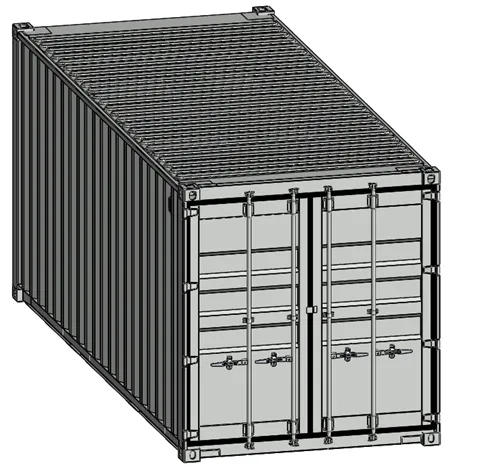
FEM Thermal Analysis of a Container in Standard and Hydrocarbon Fire Scenarios
At the start of the project, we worked with the client to determine the loads the container structure would be subjected to during an exceptional event such as an internal fire, which serves as the starting point for a reliable thermal analysis. As part of the FEM thermal analysis, we simulated two fire scenarios in accordance with the applicable standard PN-EN 1991-1-2:2006—a standard fire and a hydrocarbon fire. Each differs both in the temperature profile over time (fire curves) and in the intensity (coefficient) of heat transfer between the internal surfaces of the structure and the fire temperature, allowing for a more accurate representation of the conditions analyzed in the thermal analysis. This made it possible to precisely assess fire resistance under realistic, varied conditions.
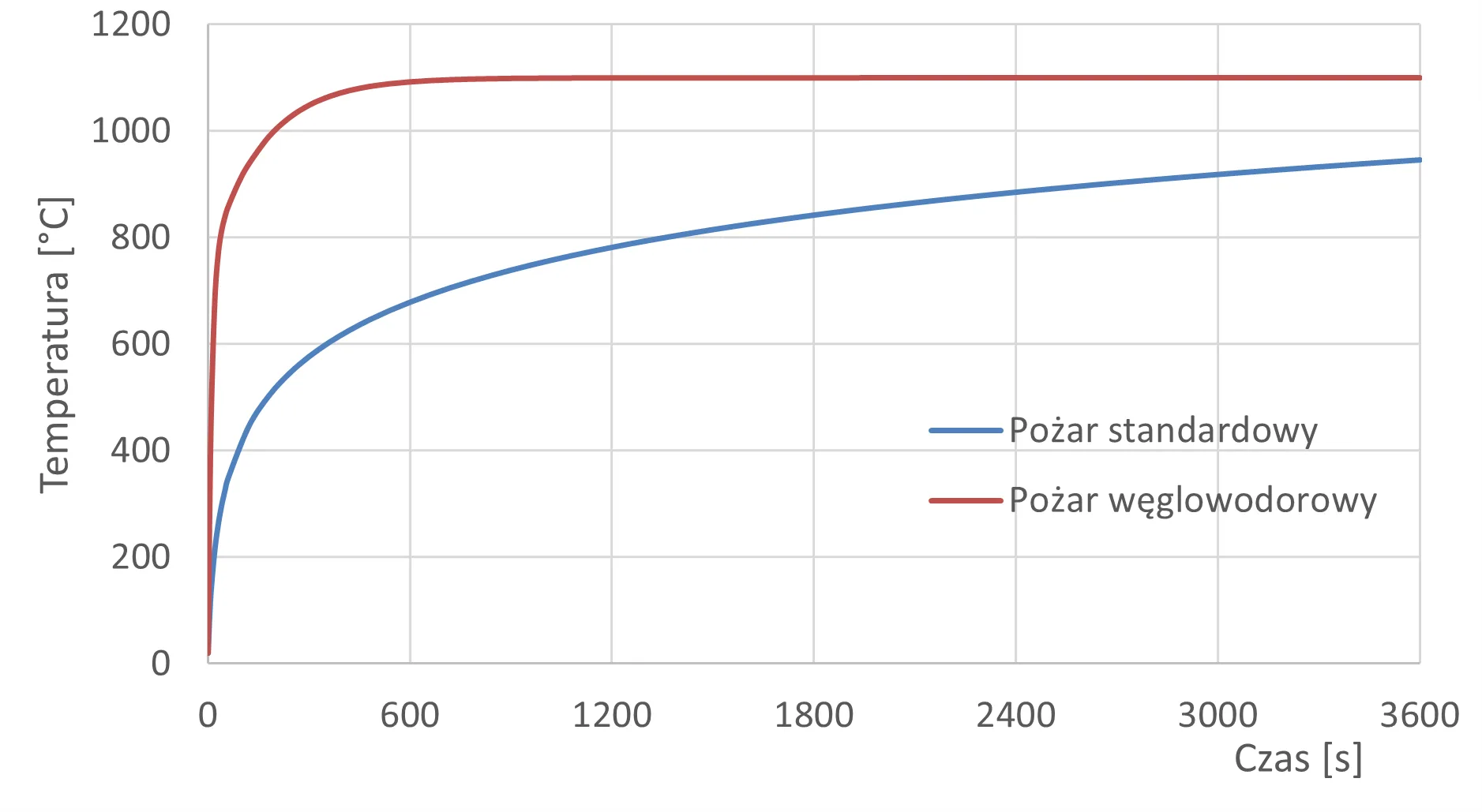
Results of the thermal analysis: fire curves and maximum structural temperatures
Due to the thin-walled construction of the module’s components, most of the FEM model was based on shell elements. The exceptions were points playing a key role in force transmission, such as corner connectors and beam elements. In the thermal model, we focused on modeling heat transfer between the container’s internal surfaces and the assumed fire curves, as well as between the external surfaces and the surrounding environment, which is crucial for a reliable FEM thermal analysis of this type of structure. Equally important was the thorough verification and modeling of contacts between the model components. Thanks to this approach, we obtained a realistic temperature distribution throughout the structure.
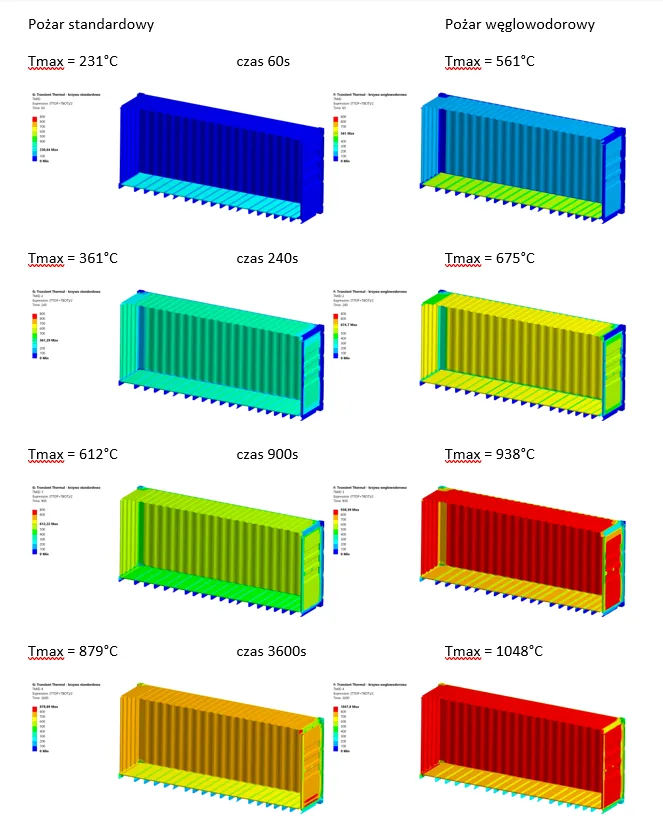
The thermal calculations were performed as time-dependent, including a simulation of the fire’s impact on the structure for 3,600 s (60 min) as part of the thermal analysis. The results of these analyses are presented in the form of temperature maps, illustrating the temperature distribution in various layers of the container at selected time points, and as temperature-versus-time plots for individual areas. This detailed analysis identified the elements most at risk of losing their mechanical properties due to overheating and served as the basis for further strength calculations in the FEM model.
Schedule free consultation with us
See how we can help your team work faster, without additional risk or cost.
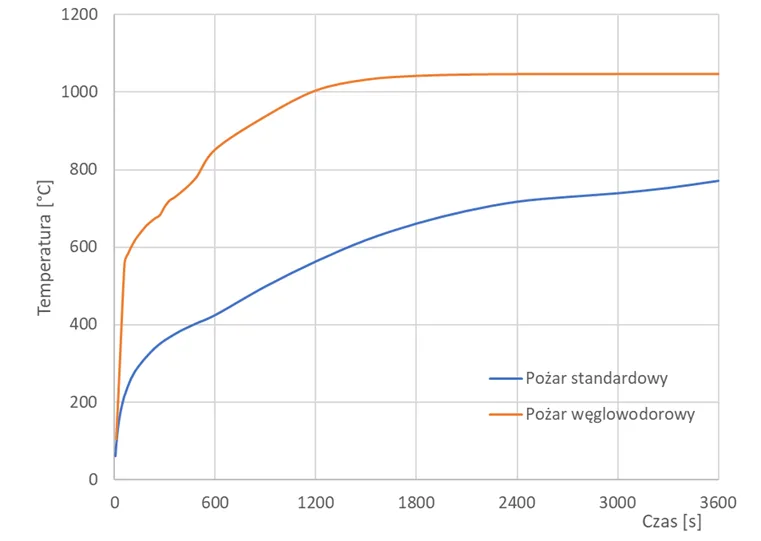
By using FEM thermal simulations, we were able to quickly and accurately assess how the temperature changes in different parts of the container during each fire scenario, which is a direct result of the thermal analysis conducted. The results clearly showed that both the rate at which the structure heats up and the maximum temperatures reached vary significantly depending on the type of fire. This, in turn, directly affects the time after which the steel structure will lose its load-bearing capacity.
FEM Analysis of Container Load-Bearing Capacity Considering the Results of a Thermal Analysis
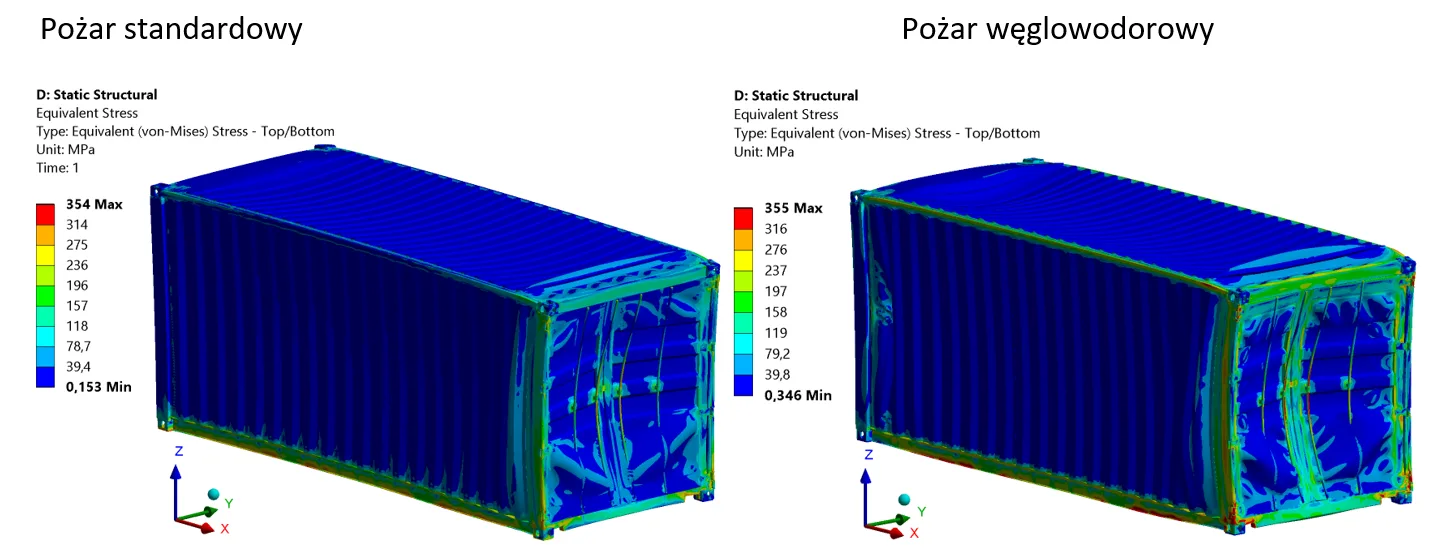
In the next phase of the project, we conducted detailed structural strength analyses to determine when the container ceases to meet safety requirements under extreme fire conditions, using the results of the previous thermal analysis. We performed the calculations based on the PN-EN 1993-1-6 standard, using the method of nonlinear material analysis (MNA), which allows us to capture the behavior of steel shells at high temperatures. The key material properties of steel for elevated-temperature conditions were adopted in accordance with the PN-EN 1993-1-2 standard.
The strength analysis covered all assumed loads: the container’s dead weight, the weight of the transported cargo, wind forces, as well as the actual distribution of fire temperatures obtained from thermal simulations as part of a prior thermal analysis. A key step was the iterative verification of the specific time point—as temperatures rose—at which the structure could no longer withstand the imposed loads. In both cases (standard fire and hydrocarbon fire), we determined that the limiting temperature at which the structure lost its load-bearing capacity was approximately 730°C. In practical terms, this meant that for a standard fire, the container maintained its integrity for approximately 50 minutes (3,000 seconds), whereas in the case of a significantly more intense hydrocarbon fire—only for 6 minutes (360 seconds).
Book a meeting with us and get your training course today
Book a meeting with us!