
EINSTEIN
EINTESTIN – Effective INtegration of Seasonal Thermal Energy storage systems IN existing buildings
CIM-mes Projekt and a consortium of 16 scientific and commercial institutions participated in the research project EFFECTIVE INTEGRATION OF SEASONAL THERMAL ENERGY STORAGE SYSTEMS IN EXISTING BUILDINGS, financed by the European Commission, FP7 — Grant Agreement no. 284932.
The project aimed to contribute to the implementation of recent EU directives by developing solutions for a significant reduction in primary energy consumption. Space heating and domestic hot water (DHW) account for the largest share of energy use in buildings; therefore, solar thermal energy represents a highly promising heat source.
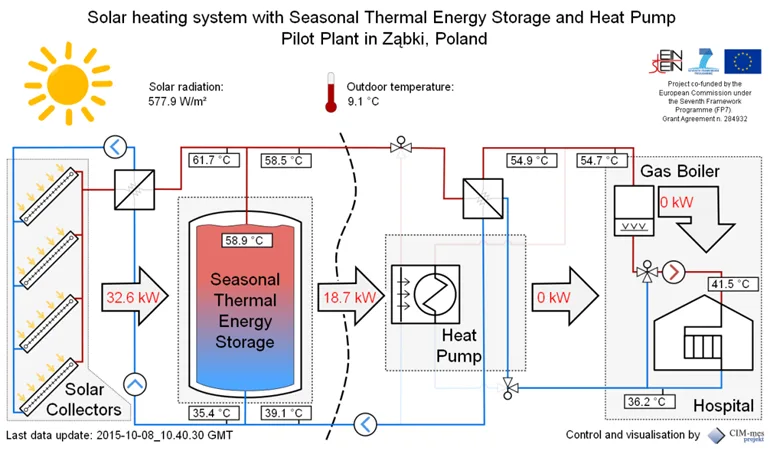
The overall objective of the EINSTEIN project was the development, evaluation, and demonstration of a low-energy heating system based on the concept of Seasonal Thermal Energy Storage (STES), combined with heat pumps to meet space heating and DHW demands in existing buildings. The system targeted a substantial reduction in energy consumption, with primary energy savings of up to 70% compared to conventional thermal systems.
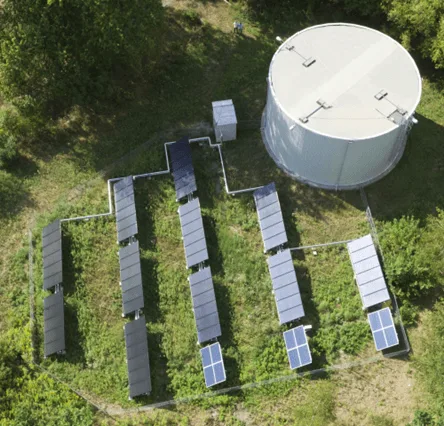
CIM-mes Projekt contributed by developing the conceptual design of the demonstrator. In this system, solar panels were used for heat collection, the captured energy was stored seasonally, and the local heating network was supplied from three sources: the STES system, a local boiler, and a heat pump.
This conceptual design enabled the development of a simulation model and the subsequent development and implementation of an Energy Management System (EMS). The EMS was deployed at a pilot site in a hospital in Ząbki (near Warsaw) and operated remotely for two years to validate the concept.
Effective INtegration of Seasonal Thermal Energy Storage Systems In Existing Buildings
Project budget: 9,030,853.77 EUR
EU contribution: 6,160,000.00 EUR